Running of the group is shared with Julia Goulden (01908 867996) and Lesley Keck (07771 758692) and Sandra Oxley
Please click here to view a fully illustrated article on the visit by Robin Souter
Meeting Format
There is no formal instruction but members learn from one another and follow a program of topics as suggested by group members. A program usually covers 13 to 14 weeks and coincides roughly with school terms. The Media used by members includes watercolours, acrylic, pastels and pencil. Oil is generally avoided due to the lengthy drying time but it is not banned some members use water based oils.
We meet weekly on Friday afternoons at Two Mile Ash and have short breaks at Christmas and Easter plus about a month off in the summer. We pay £15.00 per term which covers the cost of tea, coffee and visiting artists. We bring biscuits and milk on a rota.
We currently have no vacancies please contact Lesley, Julia or Sandra if you would like to join our waiting list.
Below some images of paintings completed this last year by members of our group:-
Mark Warner
Mark is a professional artist from Shropshire who two of our group recommended having attended a course run by him. He visited our group in November 2023.
Mark began by showing us some of his numerous sketch books. He uses watercolour sketchbooks open to a double page width, creating a panorama. He uses Black water soluble pencils such as Derwent dark wash in 4, 6 or 8B. He draws first then applies water. He spends about 45 minutes on a sketch. He also takes a reference photograph.
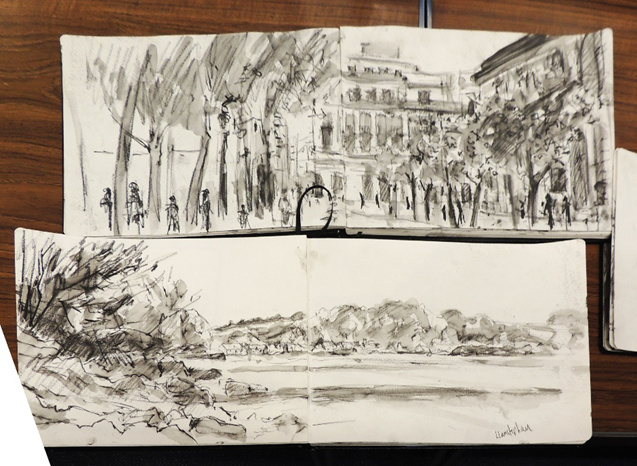
Mark often does 2 pieces of work from the same sketch to prevent over working and enable trying an idea out.
He used white water colour paper (220-240) today but frequently uses blue pastel paper. He uses synthetic brushes; a rigger to draw and a flat size 18 or 20 to fill in. The brush needs to have a resilience; not too soft or too stiff. He doesn’t use a larger flat brush because the multi directional brush strokes (his trademark) are important. He uses a limited palette cerulean blue for the sky, titanium white, mid green, hooker green, Prussian blue, Naples yellow. He never uses black, instead he mixes ultramarine and umber. He sticks a strip of the same paper (to get a true view of what the colour will look like in the painting) to test the shade he’s mixed. He uses heavy bodied acrylic paint.
He first marked out the horizon with frog tape which is easy to lift off with no mark. In this composition the horizon line did not follow the general rule of thirds.
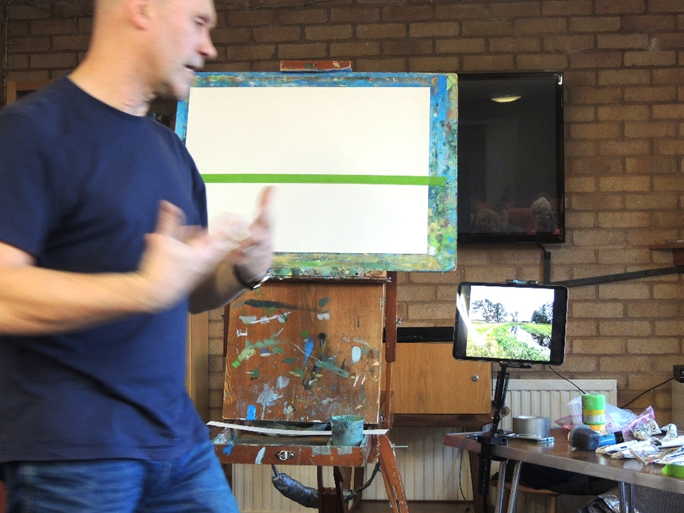
The first layer is priming dark to light at the horizon line. The overall shape was curved like a bowl.
Perspective in the sky is shown by cloud size, the clouds are lightest at the focal point. Tonal value can be checked by changing the photograph reference image into black and white, making 3 tones, light medium and dark. Dark colours are closer, lighter ones further away.
When applying layers to the clouds remember the contrast against that area of sky, the same colour will a different shade against a paler area of sky. He used Prussian blue with the white adding magenta and burnt umber for warmth for the mid tone. Look at the shape of the clouds, use a dry brush to make a fuzzy edge. Have clouds parallel to the horizon and then curve them upwards using different weights on the brush, rolling it to tickle the page. Perspective is shown by using size and tonal value. Ensure you don’t make your cloud composition into fingers. The colours in the sky are mirrored in the grass by using to blend the colours used.
He builds up the composition with layers of lines.
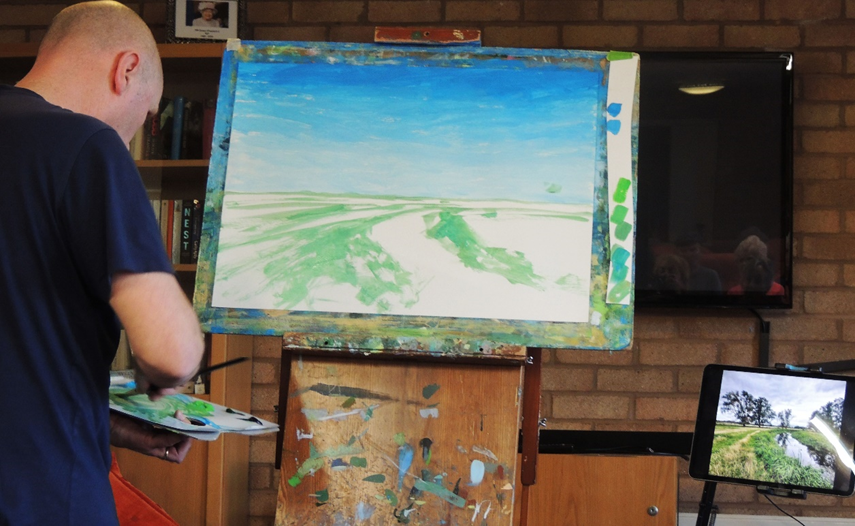
It’s important to bring in previous colours when mixing, cerulean being mixed with mid green for instance. When painting the trees, don’t dwell on one area at the start, more layers will be added. Viridian and cerulean makes a good distance green.
He paints using the side of the brush, resting his knuckles on the paper, not holding it like a pen.
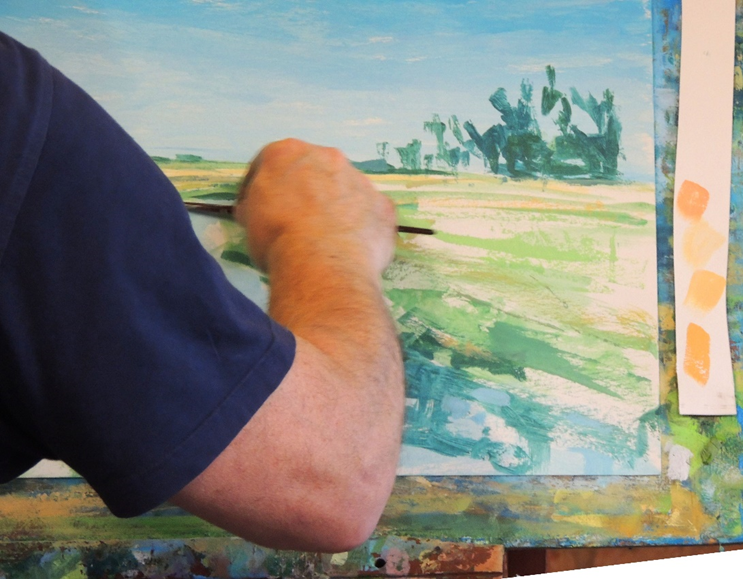
For the grass rolling the rigger with dry paint gives a feathered effect. The rigger can also be useful for making a straight line.
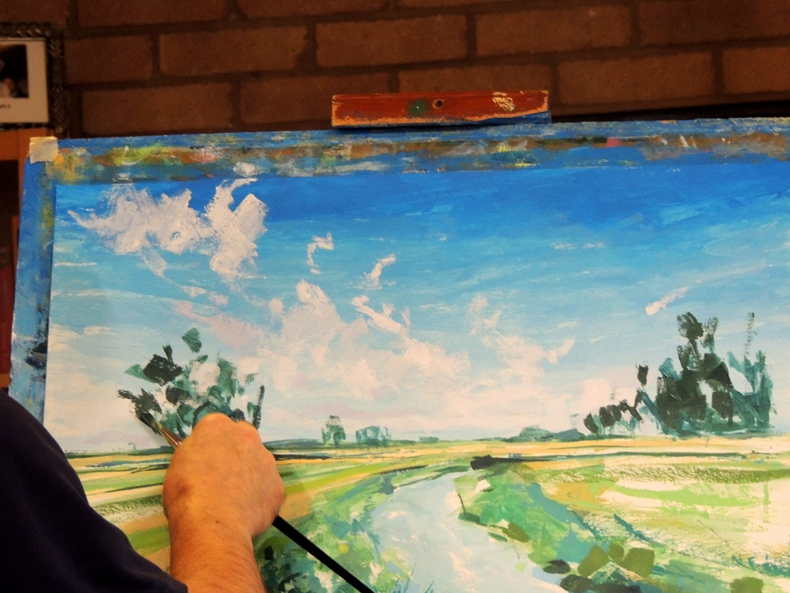
As the composition develops you can follow diagonal lines from the clouds and trees along the stream and meadow.
This is the final copy of the afternoon’s work, Mark would have worked further on the clouds and introduced more colour into the grasses given more time.
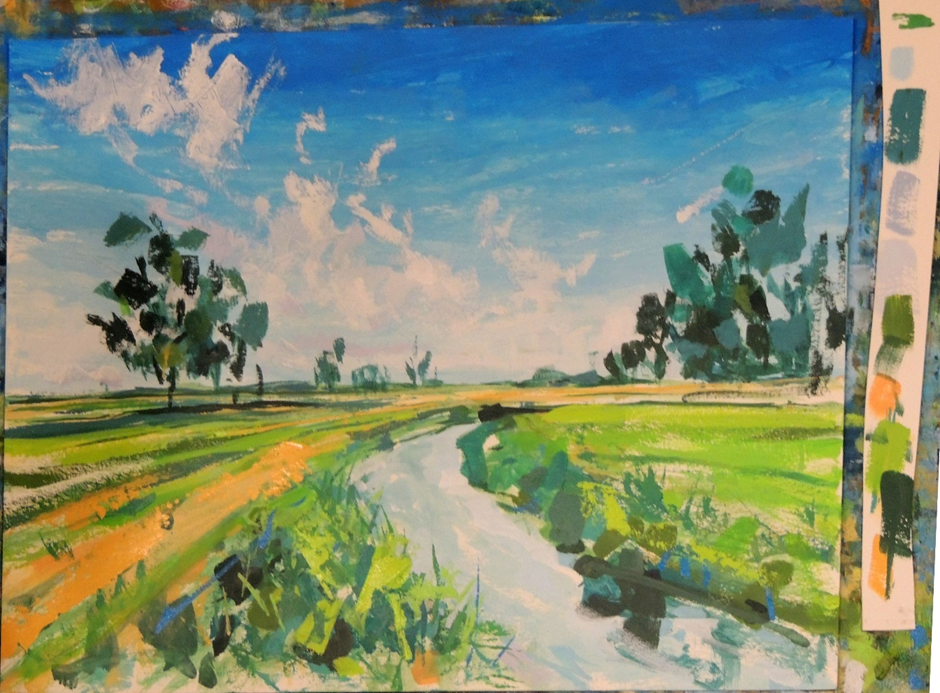
Sandra Oxley 24 Nov 2023
Mark Warner Sketching Street Scenes
Mark spends about 40 minutes en plein air sketching a street scene using water soluble pencils. He uses a soft pencil such as 4B on a double page of a landscape watercolour sketch book. The soft pencil is easy to gently erase if necessary. His set of pencils range from HB to 8B.
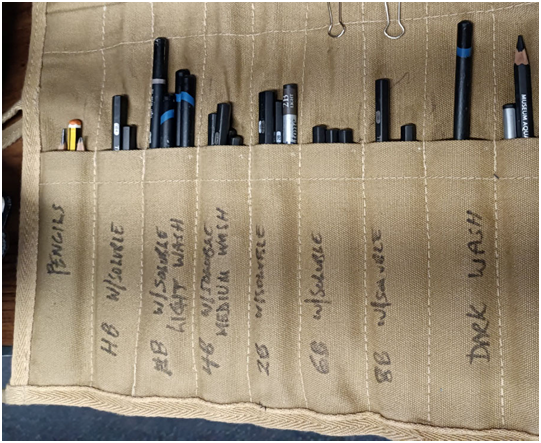
Composition is all important. He begins with very rudimentary shapes such as one block for the sky, another for the road and blocks for the buildings overall. He positions the blocks by visualising a grid on the paper, maybe pencilling in rough proportions. Onto these blocks he sketches the lines of perspective converging at the vanishing point. He uses his pencil to transfer the angle of the line to the paper making adjustments swiftly as he goes. A ruler could be used but he prefers to work free hand. He adds no detail at this stage.
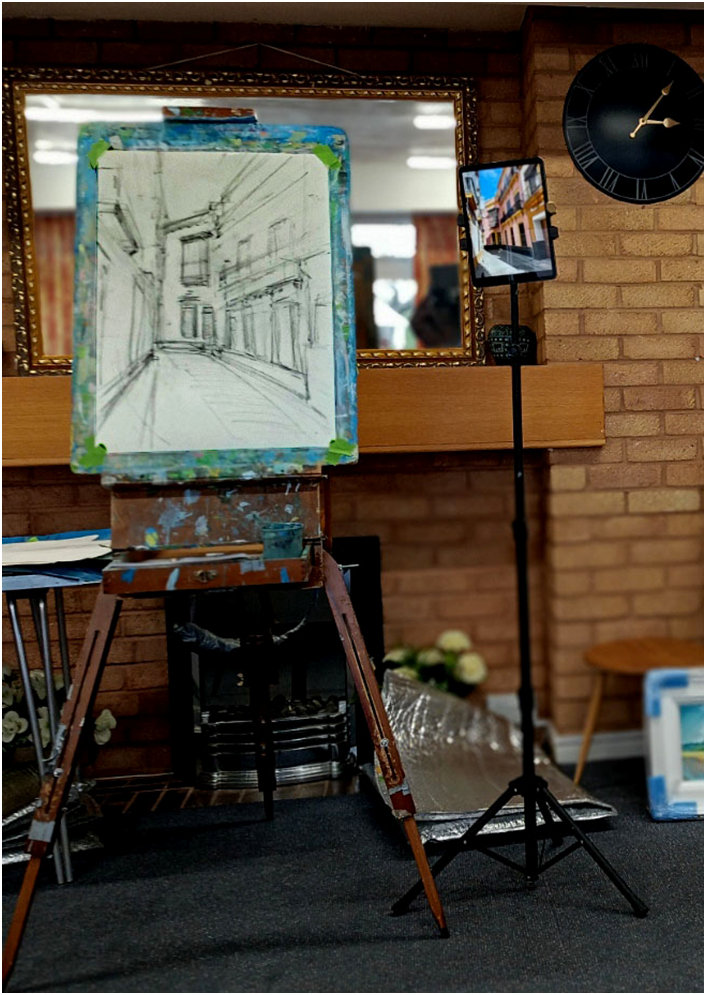
To help establish tonal values a colour photo can be turned into black and white, squinting is an alternative approach. The white paper is an important aspect of tonal values as are the negative spaces i.e. gaps. Gradually suggestions of detail are added remembering the spaces between verticals of windows will gradually increase towards the foreground, foreshortening. It’s important to cross reference to ensure relationships are maintained across the entire sketch.
Sketching is about seeing.
When Mark adds the blocks of shadows he shades in the direction of the plane of that shadow hence the road shade is shaded in horizontal lines whereas shading on the buildings follows the perspective line. He varies the pressure used to obtain different depths.
As he adds suggestions of details like windows and architectural embellishments he references how everything lines up across the pictures and checks the black and white image.
He then adds some water to blend the shading and return to the shapes he began with using a nylon number 8 brush. It is imperative to wash the brush clean between each use to keep white areas. When the sketch is dry, he then returns to reinstate the details.
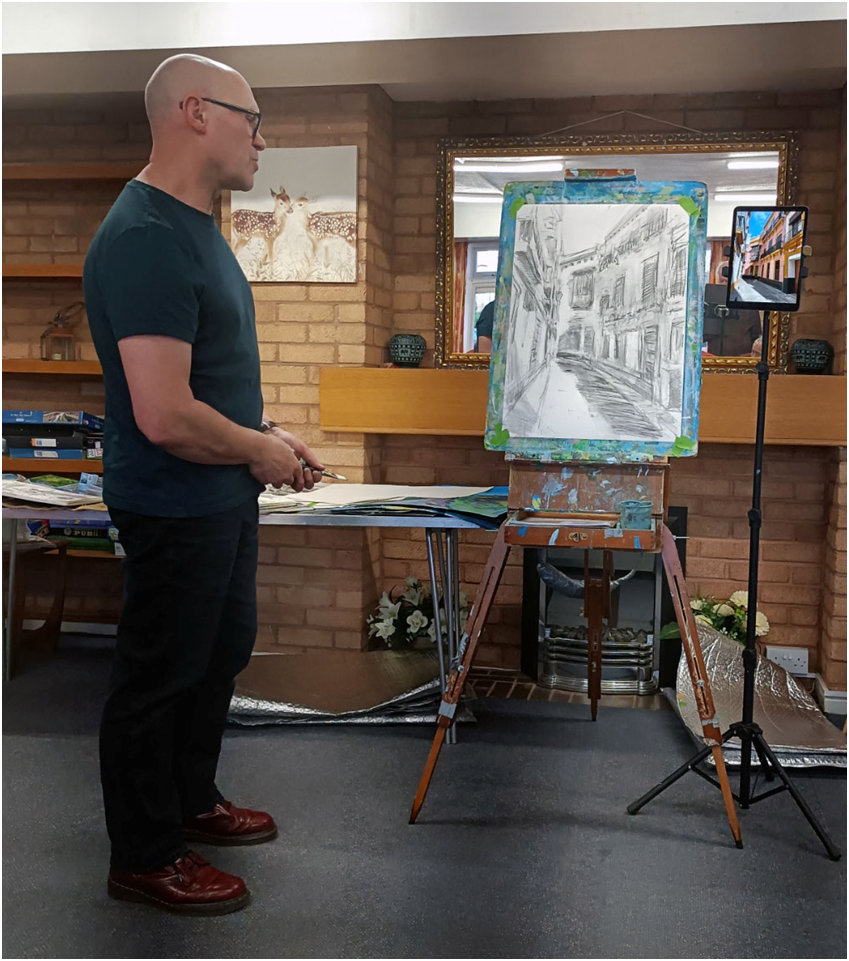
Mark with completed sketch and reference photo.
When he’s painting, he often simultaneously paints two copies giving the opportunity to experiment and compare and avoid overworking. He uses his rigger brush as a drawing tool resting his hand on the paper in the same way as he uses his pencil.
A few of the sketches he brought with him in his double page panoramic water colour sketch pad.
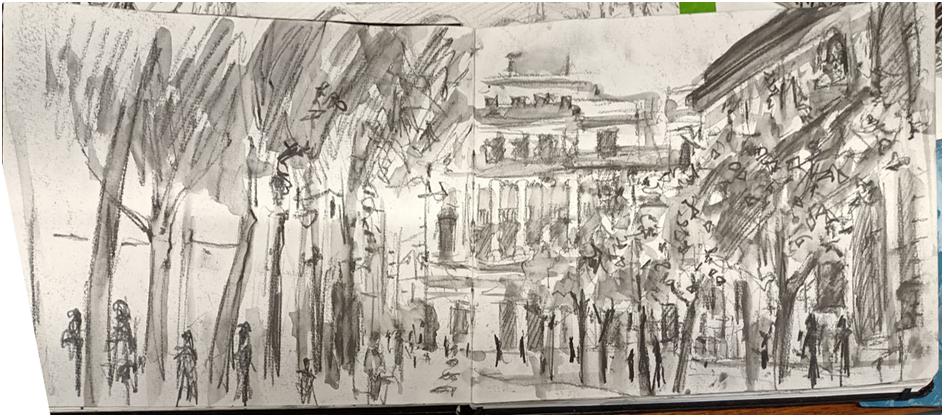
Street Scene
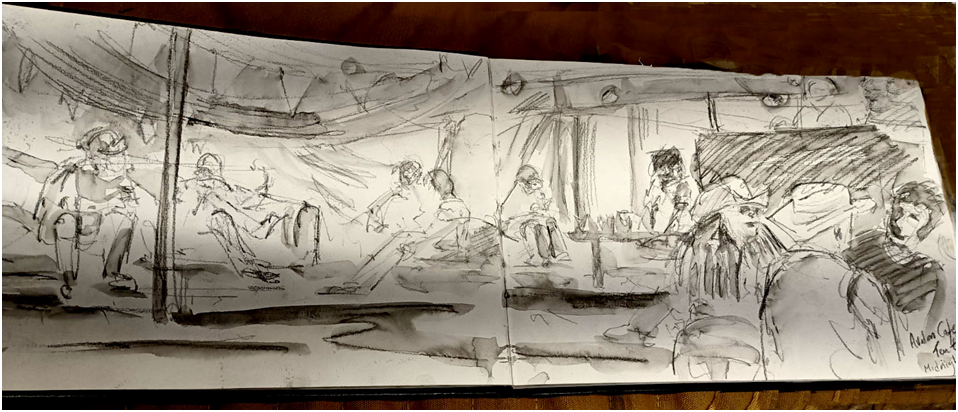
Glastonbury Festival
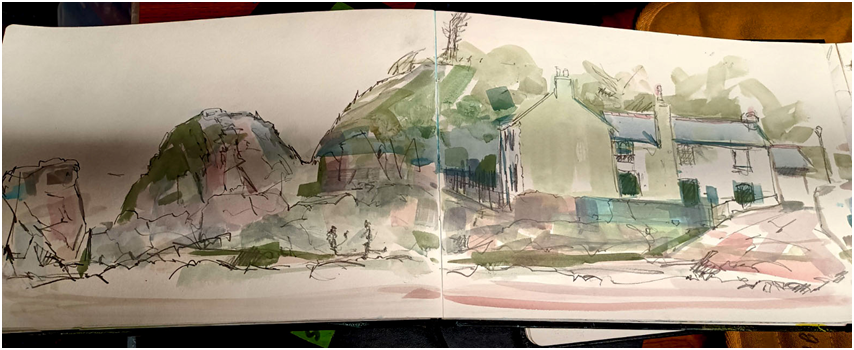
Jurassic Coast in Pencil and Acrylic
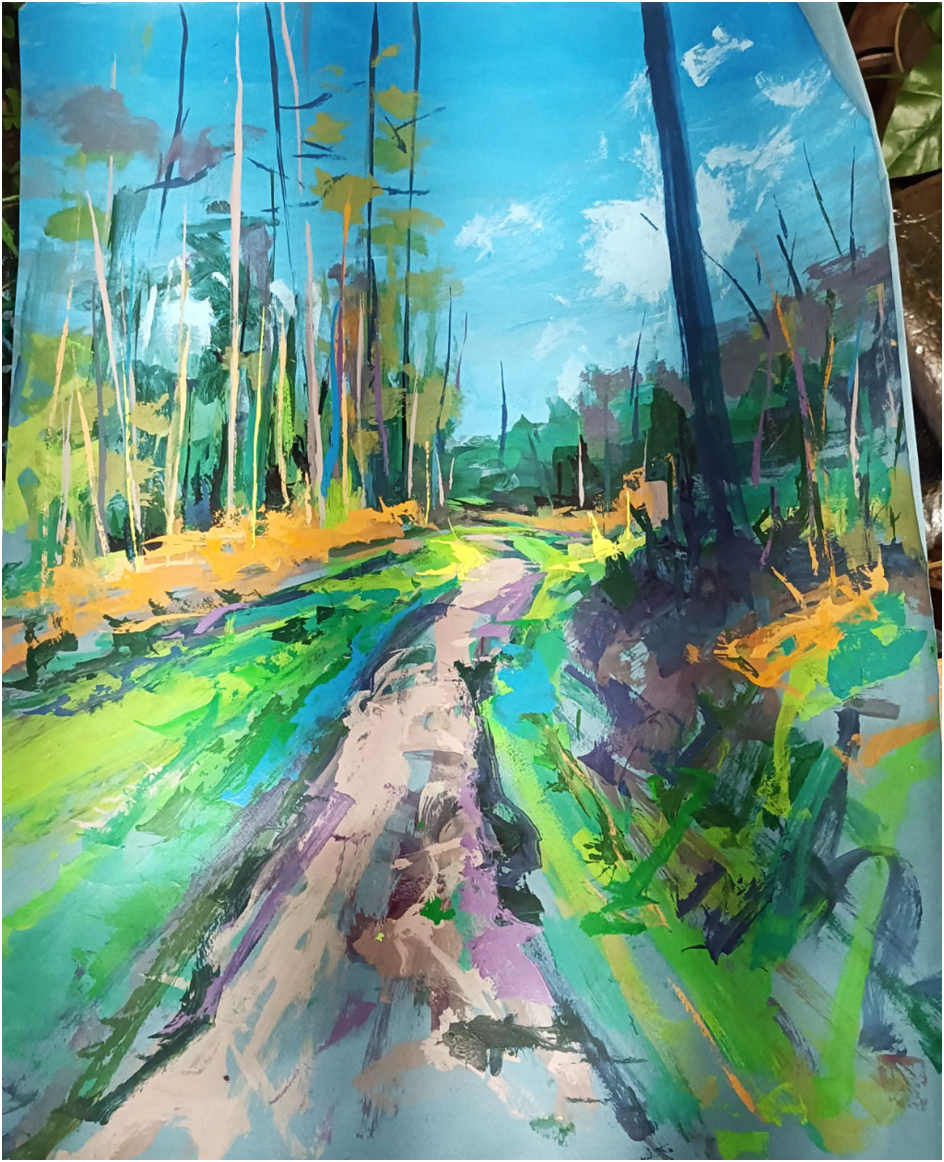
Acrylic Painting on Blue Pastel Paper
Sandra Oxley March 28th 2025
 Return to Top ▲